
How to Buy BT Cloud Voice: A Guide to New Orders, Upgrades and Legacy Migration
BT Cloud Voice is sold as three different product offerings, each fitting different customer requirements and scalability needs. Understanding which product fits your requirements and which buying route applies will determine the commercial outcome and install timeline.
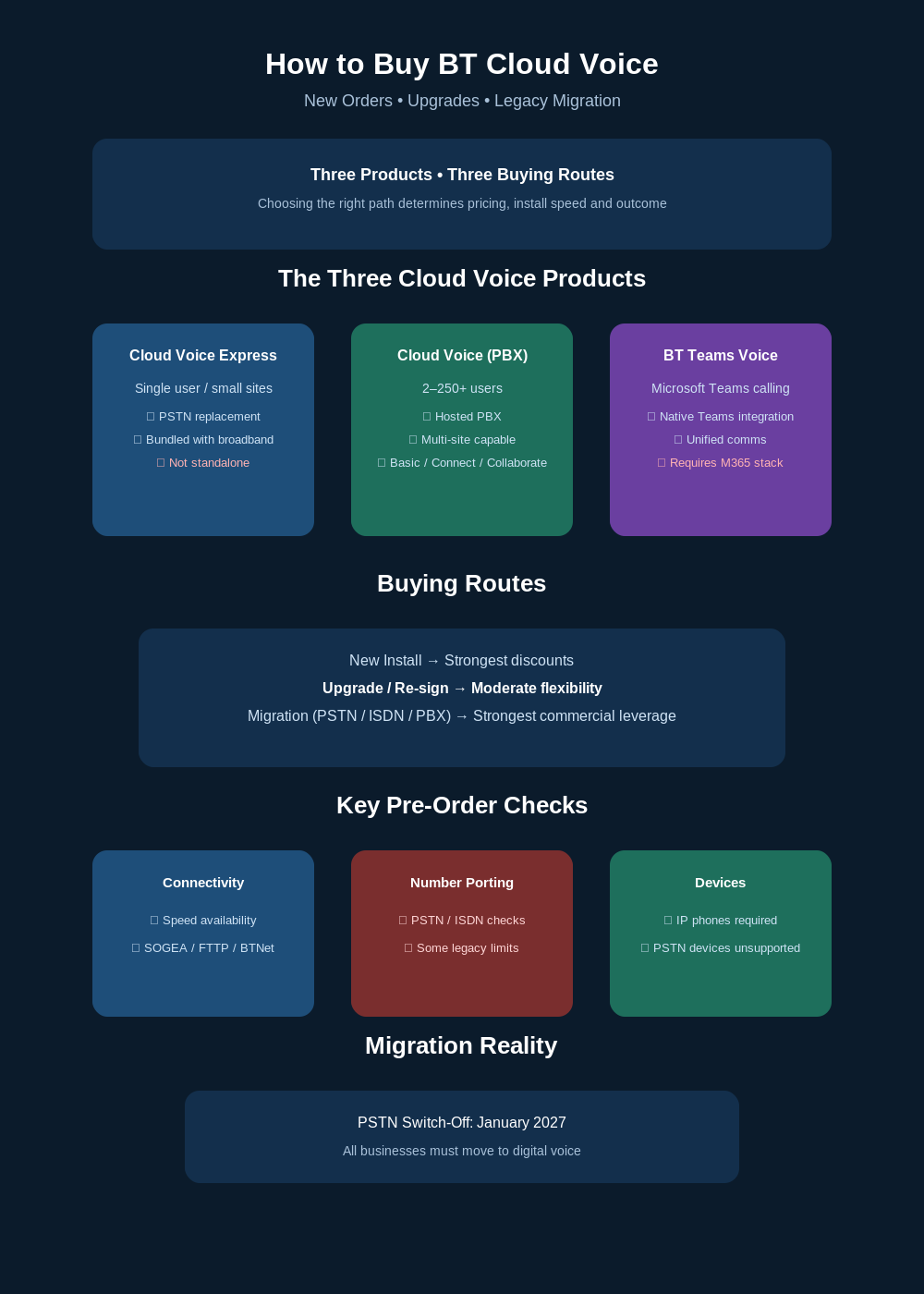
BT Cloud Voice is sold as three different product offerings, each fitting different customer requirements and scalability needs. Understanding which product fits your requirements and which buying route applies will determine the commercial outcome and install timeline. This guide will explain the options available from the portfolio and how a customer can look to install, whether they are having a new install, upgrading or migrating from a legacy phone system.
The three BT Cloud Voice products
BT Cloud Voice products span three tiers each aimed to cover a different pain point.
Cloud Voice Express (CVE) Is the smallest, entry-level digital phone line product that BT offer. Although capable of supporting up to four lines per site, it is mainly aimed at a single user and is sold bundled with BT SoGEA or FTTP (SoADSL can support also, as long as speeds are 2.5mbps or above). If the customer needs to make and take calls, they can add a UK Unlimited Calls Plan which includes a free of charge Yealink IP phone; and for those who do not need to make as many outbound calls, they can choose the Pay As You Go plan which includes a mobile app for landline calls. CVE was designed as a direct replacement for legacy PSTN lines and Featureline Compact and cannot be purchased as a standalone service.
Cloud Voice is BT’s full scale hosted PBX product, designed for 2 to 250+ users across a single site or multiple sites. BT offer three license tiers: Basic, Connect and Collaborate, of which Connect is the most popular offering due to capabilities and price point. Cloud Voice is supported by broadband (usually a BT SoGEA or FTTP, but other providers can be used provided they pass a speed test known as an Over The Top (OTT) Test) or a Leased Line (again usually BTNet but can be other provider). Cloud Voice can be sold as a standalone product or alongside other BT services.
BT Teams Voice offers the ability to call external phone numbers with digital phone line connectivity directly via Microsoft Teams. To do this, the product requires a combination of three subscriptions: Microsoft 365 to provide the Teams platform, a Microsoft Teams Phone subscription which will unlock calling within Teams itself and the BT Teams Voice subscription which will provide the carrier network connection. All of this is provided in one clear package for BT Teams Voice.
Quick selection guide
| Buyer profile | Recommended product |
| A single line, simple voice requirements, replacing PSTN (can offer two users if voice requirements are simple) | Cloud Voice Express |
| 2+ users, traditional PBX replacement, more complex voice needs | Cloud Voice (Basic, Connect, or Collaborate) |
| Microsoft Teams already deployed across the organisation | BT Teams Voice |
| Heavy collaboration with video conferencing | Cloud Voice Collaborate or BT Teams Voice |
| Call centre or contact centre features required | Cloud Voice with Call Centre ACD add-on |
| Multi-site organisation with hot desking | Cloud Voice Connect or Collaborate |
How to buy BT Cloud Voice products as a new customer
For a new BT Cloud Voice install, the sales path has to follow a defined route. Pre-order checks are vital to ensure that downstream provisioning delays are avoided and the go-live date is not affected.
Eligibility and pre-order checks
Prior to placing a new order, three checks will be made.
Technology availability and download speeds will be checked and confirmed at the installation address(s) using the BT Wholesale Checker. CVE will require speeds of 2.5mbps download to be provisioned. Cloud Voice and BT Teams Voice require a higher bandwidth to carry concurrent calls without any quality degradation. Leased Line connectivity (such as BTNet) is generally recommended for any site which is running more than ten concurrent voice users.
Secondly, it is important to check number portability. All products can have existing number ported across, but the type of lines that can be ported will differ by product. For example, CVE will support porting from PSTN, Featureline Compact, BT range holders and a majority of BT non-range holders. Most recently, BT have introduced the ability to also port across residential digital lines to CVE, which is popular with Residential to Business customers. However, CVE will not currently support porting fro BT legacy products (such as Cloud Phone) Featureline Standard, ISDN2e or IP Comms, although these changes may come in the future. Numbers that cannot port to CVE will normally be handled by the full Cloud Voice product instead.
Finally, sales exceptions will be checked. This means checking for devices that will not work natively over Cloud Voice, such as alarm lines, telecare pendants, PDQ payment terminals, CCTV systems running over PSTN, franking machines, lift emergency lines, auto-diallers, PayPoint terminals, wired analogue extensions and door entry systems running on PSTN (although, as with the above BT are always making changes and are looking to make this compatible in the near future. This check is performed because all Cloud Voice products are digital VoIP services and therefore will not support analogue devices that run on PSTN.
Handling PSTN-dependent devices
In certain cases where the customer has PSTN-dependant equipment but still wishes to migrate to Cloud Voice products, an Analogue Telephone Adapter (ATA) can in some circumstances provide a bridge. Cisco 191 and Cisco 192 ATAs can offer options for single-device deployments, or Multiport ATAs are available for larger sites needing to connect multiple analogue devices such as schools, hotels or older office buildings which are not ready for fully structured cabling. However, it is vital to check the type of devices that are supported by ATAs – devices such as CLID Loggers, fax machines, analogue telephones, Oyster Terminals and analogue bells are all supported, but specialist devices such as alarm panels, lift lines, or even more importantly telecare alarms will not be supported and may require alternative connectivity until they can link to digital.
Handset selection
There are a defined range of approved IP handsets supported by BT Cloud Voice – only approved IP devices are compatible. The Yealink T-series will cover desk phones from entry-level to high-end touchscreen models and is primarily used by Cloud Voice customers, as opposed to CVE, which is primarily supported by W73P DECT cordless handsets (although they are also compatible with full Cloud Voice). Poly VVX 250 and VVX 450 handsets are available for organisations with an existing Poly preference (but are not usually included with CVE). There are also conference solutions including the Jabra Speak 510, Poly Sync 20, Poly Trio 8300, and Yealink CP925.
There are some specific approved Algo SIP devices which act under bring-your-own-device, but these are restricted to specialist use cases such as audio alerters, SIP horn speakers, strobe lights and IP visual alerters. Standard third-party SIP handsets are not supported on the Cloud Voice platform.
Discount potential on new acquisitions
In terms of commercial position, new acquisitions are the strongest for the buyer. Network Union as an Authorised BT Partner can offer significant discounts on new BT Cloud Voice installs, subject to approval from the finance team. Although smaller orders will still access significant discounts, orders with larger user counts, longer contract lengths (3-5 years) and competitor displacement scenarios where a clear win price is established will benefit from strengthened positioning for discounts.
The structure of the deal will matter as much as the size – a five year term on Cloud Voice Connect across 30 users, for example, will attract a different commercial profile to a single year term across the same 30 user count (despite the underlying license package being identical). Although clients who have a clear scope (user count, tier, term, handset requirements) will receive a faster commercial response, those with open-ended enquiries will benefit from Network Union’s tam of product specialists, who are able to advise the best solution for the individual use-case, making the entire process smoother with a shorter time to install.
How to upgrade an existing BT Cloud Voice service
For buyers with a pre-existing BT Cloud Voice account, there are three routes to upgrade or re-sign a service: standard re-sign at contract end, tier upgrade mid-contract and adding users or features.
Standard re-sign at contract end
As a contract approaches it’s end date, the customer has the option to re-sign at any of the available term lengths: one, two, three or five years. As is often the case, longer contract terms will attract better commercial rates (although discounts are available for shorter). With BT, the re-sign window begins before the official contract end date, which gives the client tie to plan ahead and negotiate a new price without interrupting service. The re-sign window is 90 days before the contract end date, allowing time for discount review and approval.
Tier upgrades mid-contract
If a customer is choosing to upgrade their services, they can do this during the mid-term of their contract without incurring ETCs (or while incurring lower ETCs). Moving from Cloud Voice Basic to Connect, or from Connect to Collaborate both count as upgrades (CVE upgrades are based on broadband and broadband package tiers). Customers will often choose to upgrade in order to add Cisco Webex meeting capability (Connect license), call recording for compliance requirements or for full collaboration features from Webex AI Assistant (Collaborate license). Customers will often decide to upgrade rather than wait for the contract end date based on whether the new features will deliver value before the contract end date. If the contract is more than 12 months away from expiry, a mid-contract upgrade can be a better commercial option rather than waiting until the re-sign window.
Adding users and add-ons
Adding users, sites and feature add-ons are straightforward mid-contract and usually fall into two categories. Per-user features include call recording, CRM integration, hot desking and the Webex Premium add-on. Per-site features include Auto Attendant, Hunt Group Plus, Call Centre ACD and Receptionist Console.
Discount potential on upgrades
Although Network Union are able to achieve discounts on upgrade scenarios, the strongest commercial flexibility is typically narrower on new acquisitions or migrations. The strongest upgrade discounts will combine a tier increase with a meaningful user-count expansion or combine a re-sign with a hardware refresh across multiple sites. If a Cloud Voice tier upgrade is combined with a fresh broadband install or upgrade or a BTNet leased line order additional commercial flexibility may be unlocked.
How to migrate from a legacy phone system
Migration orders cover any move to BT Cloud Voice from a non-Cloud Voice product. The PSTN switch-off (full withdrawal of all UK copper-based services) is planned for January 2027, meaning that many businesses are having to think about moving to digital. After the switch-off date, no analogue voice services will operate.
Migration paths by source product
From PSTN single lines: The destination is Cloud Voice Express on a SOGEA or FTTP (or SoADSL if the former are unavailable and speeds are above 2.5mbps) bundle. Number portability is supported as mentioned previously, and options are available for each individual use-case.
From Featureline Compact: Cloud Voice Express is the direct replacement, with numbers porting across through the standard CVE process.
From Featureline Standard: CVE does not support Featureline Standard, so most of these cases will be migrated to Cloud Voice with a manual number port arranged through the order desk.
From ISDN2e or ISDN30: Supported destinations include Cloud Voice or BT Teams Voice, as ISDN cannot port directly into CVE. Channel-to-licence mapping is required to ensure concurrent call capacity matches business need post-migration.
From traditional PBX (Avaya, Mitel, Panasonic, NEC, third-party): Cloud Voice is the standard route for organisations wishing to retain a hosted PBX experience, but BT Teams Voice is available for organisations standardising on Microsoft Teams. Hardware retirement and number consolidation should be discussed prior to the cut-over date.
From third-party hosted VoIP (8×8, RingCentral, Gamma Horizon, Vonage): Number porting follows Ofcom standard processes. Can be ported to either Cloud Voice or BT Teams Voice, depending on which collaboration tooling the organisation has standardised on.
Mid-contract migration and Early Termination Charges
If a customer is locked into a legacy product mid-way through their contract they often face Early Termination Charges (ETCs) when migrating early. If migration means meaningful new revenue for BT (such as a move from Cloud Phone to Cloud Voice) an ETC waiver is often available as part of the commercial case. The Network Union is able to request this from BT, the strength of the case is usually dependent on the size of the new commitment, the remaining term on the legacy product and whether the migration will include a hardware refresh and additional services.
Building the case for an ETC waiver will require accurate documentation of the current product, current monthly charge, remaining contract term and the full details of the proposed new solution.
Discount potential on migrations
Migration sits alongside new acquisition as the strongest discount territory. The Network Union is able to secure competitive commercial outcomes on migration projects, particularly where a customer is moving multiple sites, increasing user count or upgrading collaboration capability at the same time. Combining this with a new SoGEA, FTTP or BTNet can also unlock additional waivers and credits beyond headline Cloud Voice discounts.
Summary of buying routes
| Buying scenario | BT Cloud Voice product | Discount potential |
| New CVE on SOGEA or FTTP bundle | Cloud Voice Express | Strong |
| New Cloud Voice acquisition | Cloud Voice Basic, Connect, or Collaborate | Strongest |
| New BT Teams Voice order | BT Teams Voice with M365 and Teams Phone | Strongest |
| Standard resign within window | Same product, new term | Moderate |
| Resign with tier upgrade | Cloud Voice Connect or Collaborate | Moderate to strong |
| Tier upgrade mid-contract | Cloud Voice Connect or Collaborate | Moderate |
| Migration from PSTN or Featureline Compact | Cloud Voice Express | Strong |
| Migration from ISDN, Featureline Standard, or PBX | Cloud Voice or BT Teams Voice | Strongest |
| Migration from third-party VoIP | Cloud Voice or BT Teams Voice | Strongest |
Choosing the right buying route
The best buying route will depend on product selection – which will in-turn depend on user count, broadband infrastructure and Microsoft Teams adoption position. Once this is understood, the rest of the order will assemble cleanly. Cloud Voice Express would not be suitable for a 60-user multi-site organisation, while placing a single-line solo operator onto Cloud Voice Basic would add unwanted operational complexity.
The buying scenario will dictate the commercial conversation – new acquisitions and migrations will carry the strongest discount profile because both bring brand new commitment to BT. Upgrades and re-signs usually work within a narrower commercial range because BT already has a relationship with the customer. The Network Union has the knowledge to understand from the beginning which conversation is best to have and can access BT’s Asset Viewer (with the customer’s consent) to see what products currently exist on the account and where they are in their contract. This saves weeks of cycling between the buyer and the BT order desk. As a BT Authorised Partner specialising in Cloud Voice procurement, Network Union will handle all three scenarios through to the end, including new customer eligibility checks, upgrade modelling against existing service, and full migration project management for legacy displacement projects all run through a single point of accountability. All commercial outcomes are subject to full BT approval at the point of order.
BT Cloud Voice Pricing Calculator
Use our free BT Cloud Voice pricing calculator to estimate costs for your business. Configure users, call bundles and handsets to get an instant indicative price.