
BT One Phone Replacement: Moving to BT Cloud Voice with a BT Authorised Partner
Since March 2026, BT One Phone has been switched off - however for most BT customers, the practical replacement is BT Cloud Voice, BT Cloud Voice plus BT Business Mobile or Microsoft Teams Phone via BT.
Short answer
Since March 2026, BT One Phone has been switched off - however for most BT customers, the practical replacement is BT Cloud Voice, BT Cloud Voice plus BT Business Mobile or Microsoft Teams Phone via BT. Netify works with Network Union, a BT Authorised Partner since 2012, to assess which route fits best for each business.
Key facts
- BT One Phone was switched off in March 2026.
- Network Union has been a BT Authorised Partner since 2012.
- BT Cloud Voice entry pricing starts at £9.52 per user per month (on a 60 month contract).
- BT Cloud Voice number porting typically completes within four hours on cutover day, ensuring your business a smooth transition.
What replaces BT One Phone?
For most small and mid-sized BT customers, the closest replacement is BT Cloud Voice - already built to handle many of One Phone’s capabilities such as supporting desk users, hunt groups, inbound calls and Auto Attendant. However the absence of One Phone’s mobile work capabilities (for field staff and area managers) is better replicated by BT Cloud Voice plus BT Business Mobile. Further to this, where businesses are already heavily using Microsoft 365 products, switching to Teams Phone via BT becomes a more ideal route to hosting all workflows in one place.
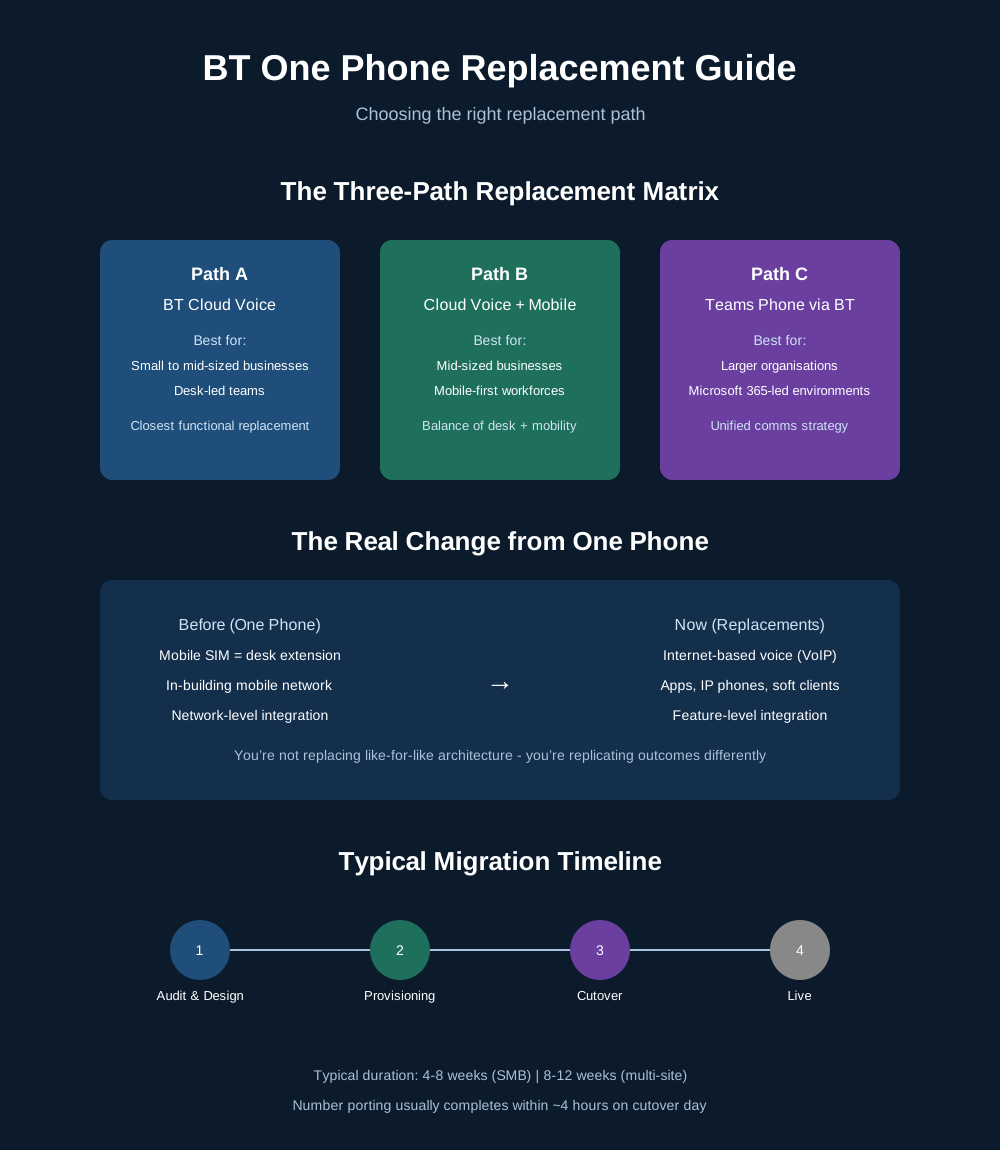
Netify and Network Union group those choices into our Three-Path Replacement Matrix:
- Path A is BT Cloud Voice as the main replacement.
- Path B is BT Cloud Voice plus BT Business Mobile.
- Path C is Microsoft Teams Phone via BT.
We’d suggest that the best option for your business is likely far less dependent on pricing and more on how staff actually used One Phone every day.
Why this guide carries weight
Replacing BT One Phone is not just a feature comparison, it’s a migration problem, a commercial problem and in some cases a contract problem. The main risk is missing the handful of One Phone behaviours that quietly mattered to the business and then finding out on go-live week, however, as the Network Union has been a BT Authorised Partner since 2012, we’re best suited to help you work out what’s needed and what’s not.
The Three-Path Replacement Matrix
Path A. BT Cloud Voice as a like-for-like replacement
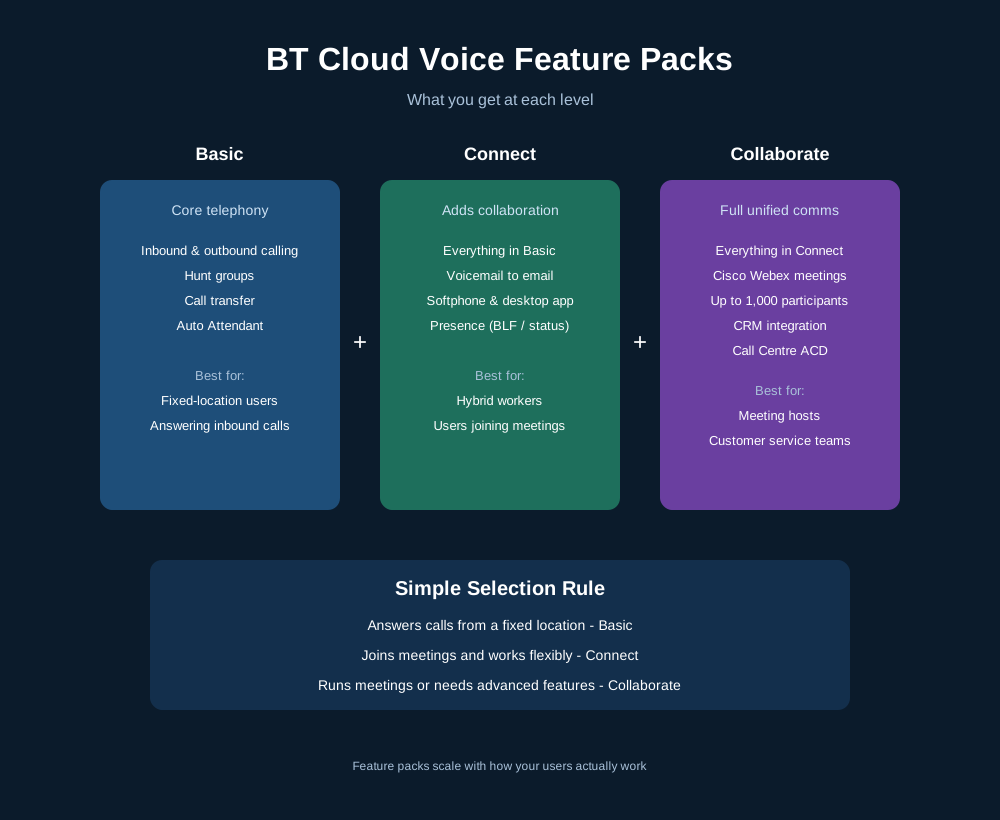
BT Cloud Voice is BT’s primary offering for replacing BT One Phone, designed to fit the needs of mostly desk-led businesses (with occasional mobile use). It’s worth noting that features do vary based on BT Cloud Voice’s feature packs (Basic, Connect and Collaborate), with an optional Webex Premium add-on on Collaborate - across those features packs, BT offers capabilities such as:
- Hunt groups,
- Call transfer,
- Auto Attendant,
- Call Centre ACD,
- CRM integration through CRM Integrator or CRM Lite,
- Cisco Webex meetings up to 1,000 participants on Premium.
Entry pricing for BT Cloud Voice starts at £9.52 per user per month (on a sixty-month contract), though the actual pricing will depend on the user mix, as feature pack set, handset choice and connectivity options.
Our recommendation is that, if most users answered calls from a fixed location (e.g a desk) and require business features over mobile-first behaviour, BT Cloud Voice (Path A) is usually the best fit.
Path B. BT Cloud Voice plus BT Business Mobile
Alternatively, for those businesses who are more mobile-first and may not be suited to the fixed location basis of Path A, BT Cloud Voice plus BT Business Mobile is a better fit for the likes of field engineers, sales teams, mobile account managers and service staff (who are rarely at a desk). With this setup, BT Cloud Voice handles the desk and call-management layer, whilst BT Business Mobile handles mobile - making it capable of replicating much of the business outcome of One Phone (even if it does not recreate the architecture).
Although architecturally different to One Phone, BT Cloud Voice plus BT Business Mobile can keep one supplier relationship, preserve business numbers and core call-routing features, alongside also giving mobile users the freedom they need for continuing current operations.
Path C. Microsoft Teams Phone via BT
Finally, for organisations already leveraging Microsoft 365 for much of daily operations and are keen to reduce app sprawl, Microsoft Teams Phone via BT can be an ideal replacement for BT One Phone. With this, BT can deliver Teams Phone through a calling plan layered onto existing Teams licensing, or through Operator Connect, with BT supplying numbers and calling services inside the Teams environment - making voice part of the same application already used for chat and meetings.
Typically we’d suggest that this path is more aimed towards larger businesses as it also introduces a Microsoft licensing and administration conversation that smaller firms often do not want.
Replacement path summary
Path | Best fit | Main strength | Main trade-off |
BT Cloud Voice | Desk-led teams with some mobile use | Closest practical BT-led replacement | Moves away from One Phone mobile architecture |
BT Cloud Voice plus BT Business Mobile | Mobile-first teams | Preserves supplier continuity and mobile flexibility | Split portal and no network-level One Phone behaviour |
Microsoft Teams Phone via BT | Microsoft 365-led organisations | One identity for chat, meetings, and voice | More licensing and admin complexity |
BT One Phone vs BT Cloud Voice
The table below compares BT One Phone and BT Cloud Voice using BT product information. The final column is Netify and Network Union judgement as a BT Authorised Partner, not BT judgement. That column highlights where a former One Phone customer will feel the difference in daily use.
Capability | BT One Phone | BT Cloud Voice | Gap for former One Phone customer |
Primary device architecture | Mobile SIM with in-building mobile network | IP handset, softphone, desktop app, mobile app over internet | Desk-first shift |
One business number across devices | Yes, at network level | Partial, through application-layer tools such as Call Director and shared call appearance | Similar outcome, different architecture |
Hunt groups and IVR | Yes | Yes, through Hunt Group, Auto Attendant, Call Centre ACD | No major gap |
Presence | Yes | Yes, through Busy Lamp Field and Webex presence | No major gap |
Unified voicemail | Yes | Yes, with voicemail-to-email on Connect and Collaborate | No major gap |
Mobile device management | Included through One Phone service design | Not included in Cloud Voice | Must be added separately if required |
Connectivity dependence | EE mobile network plus picocells | BTnet or BT Business fibre broadband recommended | Internet dependency becomes more important |
What customers keep, lose and gain
What stays
In our experience, customers will typically keep business numbers (through standard BT porting), with crossover within around 4 hours on the cutover day. On top of this, customers also get to keep their BT commercial relationship, which can be useful for businesses with multi-site billing, other BT services or a named account manager.
What goes
Whilst the business numbers stay, customers will lose the network-level SIM-and-extension architecture that was provided by One Phone, as well as losing having a single portal that combined both the mobile and PBX offerings into a single place. Furthermore, if businesses previously used MobileIron Cloud as part of their previous setup, device security will need to be additionally addressed.
What arrives
BT Cloud Voice enables a greater handset range that BT One Phone, with handset options including:
- Poly VVX 150,
- Poly VVX 250,
- Poly VVX 450,
- Poly CCX 500,
- Yealink T43U,
- Yealink T46U,
- Yealink T48U,
- Yealink T54W,
- Yealink CP920,
- Poly Trio 8300,
- Yealink W53 DECT solution.
On higher tiers of the BT Cloud feature sets, businesses can also gain access to Cisco Webex meetings for up to 1,000 participants, CRM integration and Call Centre ACD for distributed service teams.
What a realistic migration looks like
For many small and medium businesses, moving from BT One Phone to BT Cloud Voice often takes four to eight weeks from order to go-live, whilst larger multi-site deployments often run eight to twelve weeks. Within this period, the first stage consists predominantly of audit and design, followed by provisioning and number planning and then the final stage, cutover and porting, with numbers usually live within four hours.
In our experience, the most common delay is down to uncertainty over which feature-pack to choose - whilst The Network Union can assist with this, the following simple rule helps in most cases:
- Runs meetings: Collaborate.
- Joins meetings: Connect.
- Answers inbound calls from a fixed spot: Basic.
The Network Union BT One Phone Migration Assessment
Here at Netify and Network Union we utilise a five-step process known as The Network Union BT One Phone Migration Assessment to help assist in the process.
- Usage Audit - Within this we review total users, SIMs, call flows, in-building coverage needs and which staff actually depend on each feature.
- User Classification - Split users into desk-majority, mobile-majority and hybrid settings, allowing mappings to Path A, B or C (BT Cloud Voice, BT Cloud Voice plus BT Business Mobile or Microsoft Teams Phone via BT).
- Number Portability - Within this, check every number, hunt group and shared ringing pattern before any replacement route is approved.
- Hardware and Device Management - Confirm which desk phones, conference phones and cordless devices are needed, as well as whether any mobile device management layer needs replacing.
- Commercial Review - Check contract end dates, any remaining commitment and whether BT withdrawal changes the commercial position.
At the end of the five steps of the migration assessment, you should find yourself with a recommended replacement path, an indicative quote and a realistic migration timeline.
Common questions
Is BT One Phone still available?
No - BT One Phone is no longer available due to being switched off in March 2026.
Will BT Cloud Voice recreate One Phone exactly?
No - though BT Cloud Voice can recreate much of the same outcome for businesses, but just not via the same original One Phone mobile architecture.
How long does a move usually take?
Four to eight weeks for many small and medium businesses and for larger or multi-site estates often take eight to twelve weeks.
Will One Phone handsets work with BT Cloud Voice?
Unfortunately not, no. BT Cloud Voice uses its own IP handset and softphone environment.
Can BT customers keep existing numbers?
Usually yes - this can often be done through standard BT number porting, with the porting process typically taking around four hours on the cutover day.
Who should choose Teams Phone via BT?
The strongest use case for Teams Phone via BT is businesses that are already heavily integrated with Microsoft 365 products and have internal IT capabilities to manage a more involved voice setup.
Final recommendation
For most former BT One Phone customers, whilst it can be obvious to move to BT Cloud Voice from BT One Phone, it can be less obvious which Cloud Voice product to move to. The first question is whether the business was desk-led, mobile-led or Microsoft 365-led and once that is clear, the path is usually clear as well.
Netify and Network Union recommend BT Cloud Voice as the default replacement for most desk-led BT One Phone customers, BT Cloud Voice plus BT Business Mobile is stronger where mobile work sat at the centre of the old setup and Microsoft Teams Phone via BT is best for organisations already committed to Microsoft 365 and willing to accept more setup complexity.
For the fastest answer, we would recommend that businesses start with our Three Path Replacement Matrix, run The Network Union BT One Phone Migration Assessment and then request pricing based on actual users, feature packs and handset mixes.

Harry holds a BSc (Hons) in Computer Science from the University of East Anglia and is ISC2 Certified in Cybersecurity (CC). He serves as a Cybersecurity Writer here at Netify, where he specialises in enterprise networking technologies. With expertise in Software-Defined Wide Area Networks (SD-WAN) and Secure Access Service Edge (SASE) architectures, Harry provides in-depth analysis of leading vendors and network solutions.
Fact checked by: Robert Sturt - Managing Director, Netify