
Azure vs AWS for Enterprise SD-WAN and SASE Integration
Azure and AWS have moved beyond simply being destinations for traffic; they now act as the middle-mile backbone for the global enterprise. By using the private global networks of these providers, businesses can replace unpredictable internet transit with more stable, high-performance paths. However, the way each provider handles routing, third-party appliance integration, and regional presence in the UK will influence the complexity of your deployment.
Here's the good news: two industry giants, Microsoft and Amazon, both have cloud solutions that can upgrade your team into the 21st century. But the question is, which is the right solution for you? Here, we're weighing the features of Microsoft Azure vs Amazon AWS to show you what you need to know to make an informed decision.
SD-WAN and SASE Integration: Azure vs AWS at a Glance
Choosing between these two giants requires looking specifically at how they bridge the gap between your branch offices and your cloud-hosted workloads. The following table provides a comparison of the key networking components and cost entry points for UK-based deployments.
| Factor | Microsoft Azure | Amazon AWS |
| Native SD-WAN integration | Azure Virtual WAN (vWAN) | AWS Transit Gateway |
| Supported SD-WAN vendors | Cisco, Fortinet, Versa, Broadcom VeloCloud, HPE Aruba EdgeConnect, Barracuda | Cisco, Palo Alto, Fortinet, Aruba, Aviatrix, Versa |
| SASE integration | Via Azure Entra ID & third-party SSE (e.g. Zscaler, Netskope, Palo Alto Prisma Access) | Via AWS Transit Gateway & third-party SSE (e.g. Zscaler, Netskope, Cloudflare One) |
| UK regions | UK South (London), UK West (Cardiff) | eu-west-2 (London) |
| Private connectivity | Azure ExpressRoute | AWS Direct Connect |
| Typical WAN hub cost | ~£136.80/month (Standard Hub) & ~£41.48/month (50 Mbps ExpressRoute circuit, UK South) | ~£26.64/month (per attachment) & ~£165.60/month (1 Gbps Direct Connect port, eu-west-2) |
| Best for SD-WAN when... | Microsoft 365-heavy environments; Entra ID as the identity layer | Multi-cloud or AWS-native workloads requiring high-bandwidth cloud-on-ramp |
Which Cloud Is Better for SD-WAN - Azure or AWS?
In our view, there is no single superior platform, but there is usually a most logical choice based on your current estate. If your organisation is heavily invested in the Microsoft 365 ecosystem and uses Entra ID (formerly Azure AD) as your primary identity layer, Azure is the natural fit. The integration between Azure Virtual WAN and Microsoft's SaaS applications allows for optimised routing that is difficult to replicate with the same simplicity elsewhere. For UK firms, Azure also offers the advantage of two distinct regions (London and Cardiff), which can be useful for specific disaster recovery or data residency requirements.
Conversely, AWS tends to be the preferred choice for organisations with high-performance, AWS-native workloads or those pursuing a strict multi-cloud strategy. AWS Transit Gateway gives teams more direct control over routing tables and BGP configurations than Azure vWAN's managed model. If your IT team requires high-bandwidth on-ramps for data-heavy applications, AWS Direct Connect's port options and the Transit Gateway Connect feature provide a highly scalable way to link third-party SD-WAN controllers directly into the AWS backbone.
How Does Azure Virtual WAN Work with SD-WAN?
Azure Virtual WAN (vWAN) functions as a managed networking service that brings together networking, security, and routing under a single interface. It uses a hub-and-spoke architecture where the hub is a Microsoft-managed virtual network. For SD-WAN integration, your branch CPE (Customer Premises Equipment) establishes IPsec/IKEv2 tunnels to the vWAN hub.
The platform supports a built-in integration model with specific partners including Fortinet, Cisco, Versa, Broadcom VeloCloud, HPE Aruba EdgeConnect, and Barracuda. In this model, the SD-WAN controller can automate tunnel provisioning, making the cloud-on-ramp process more consistent. ExpressRoute can also terminate directly into the vWAN hub, allowing the hub to act as a central transit point between branch offices, data centres, and Azure VNets. It is worth noting that you are operating within a managed framework where Microsoft controls the underlying routing logic - this simplifies operations but limits certain customisation options.
How Does AWS Transit Gateway Work with SD-WAN?
AWS Transit Gateway acts as a regional network transit hub, enabling organisations to connect VPCs, on-premises networks, and SD-WAN overlays at scale. Unlike a standard VPN, Transit Gateway is designed to handle thousands of attachments. For SD-WAN integration, AWS introduced Transit Gateway Connect, which allows third-party SD-WAN appliances to establish GRE (Generic Routing Encapsulation) tunnels rather than just standard IPsec.
GRE tunnels support BGP more natively, allowing for higher throughput and better dynamic routing between your SD-WAN fabric and the AWS network. AWS Network Manager provides a centralised dashboard for visibility across the entire global network, including on-premises SD-WAN devices across multiple AWS regions. In practice, this architecture works best for teams who want to maintain consistent routing policies across both their physical data centres and their cloud environments.
Can You Run SASE in Azure or AWS?
You can run a SASE architecture within both environments, though neither Azure nor AWS currently provides a single-vendor, end-to-end SASE solution that matches the depth of specialist providers. Instead, enterprises use the cloud platform as the connectivity layer whilst integrating third-party Security Service Edge (SSE) providers for the security functions (ZTNA, SWG, and CASB).
In an Azure environment, the most common approach is to route branch traffic via Azure vWAN to an SSE provider such as Zscaler or Netskope before it reaches the internet or internal applications. This is typically tied together using Entra ID for identity-based access control. In AWS, traffic is directed from the Transit Gateway to the SSE provider's PoP (Point of Presence). AWS also offers native tools such as AWS Verified Access for ZTNA-style connectivity, which can supplement a third-party SASE deployment. Because major SASE vendors maintain PoPs within both Azure and AWS data centres, the latency impact is generally minimal in practice.
The quality of the SSE vendor's integration with each platform is a due-diligence question worth raising early in any procurement process, some vendors have deeper API-level integrations with one platform than the other, which can affect automation, policy consistency, and support escalation paths.
Choosing the Right Cloud for Your SD-WAN or SASE Deployment
Selecting between Azure and AWS for your WAN backbone is less about the cloud services themselves and more about where your existing infrastructure gravitates. Azure offers an integrated, Microsoft-centric experience that simplifies the path for Microsoft 365 users, particularly with its dual-region UK presence. AWS provides a more flexible, high-throughput routing environment that suits complex, multi-cloud architectures.
In our experience, the decision often comes down to which platform your network team is most comfortable managing, and how well your chosen SD-WAN vendor integrates with each provider's API.

Robert Sturt is a leading expert in SD-WAN and enterprise network solutions with extensive experience in telecommunications and network infrastructure. As a Forbes Business Council member and contributor to TechTarget, he provides strategic insights on network transformation and digital connectivity solutions. His expertise spans SD-WAN implementation, network security, and enterprise digital transformation initiatives.
Fact-checked by: Harry Yelland - Cybersecurity Writer, Netify
Frequently Asked Questions
What's the difference between Microsoft Azure and Amazon AWS?
On the surface, Azure and AWS are pretty similar systems. They're designed to cover many of the same areas and offer comparable functionality to solve the same set of problems.
AWS has four categories of services under IaaS:
- Compute
- Content delivery and storage
- Database
- Networking
Azure also has four class offerings:
- Compute
- Performance
- Data management and databases
- Networking
But when you get down to it, which is the better option for your business's money? That depends on what you're looking for in a system.
How do AWS and Azure Features and Services Differ?
In terms of basic capabilities, AWS and Azure are pretty similar. They share all of the common elements of public cloud services: self-service, security, instant provisioning, auto-scaling, compliance and identity management.
However, between the two, AWS offers the greatest depth, with 140 services across computing, database, analytics, storage, mobile and developer tools. Keep in mind, however, that they have a head start on everyone else since they've been around the longest.
That said, Azure is also strong on the features and services front and has a parent company that has the resources to hold their own against Amazon.
What's the difference in Computing power between AWS and Azure?
One front for comparison is computing power, which is a standard requirement for any IT team. If you're going to invest in cloud services, it is important to ensure that there is enough horsepower to keep up with your office's demands on a day-to-day basis (and during high-traffic periods).
The primary issue here is scalability. AWS uses elastic cloud computing (EC2), which is when the available resource footprint can grow or shrink on demand using cloud computing, with a local cluster providing only part of the resource pool available to all jobs.
AWS EC2 users can configure their own virtual machines (VMs), choose pre-configured machine images (MIs), or customise MIs. Users have the freedom to choose the size, power, memory capacity and number of VMs they wish to use.
Azure users, on the other hand, chose a virtual hard disk (VHD) to create a VM. This can be pre-configured by Microsoft, the user, or a separate third party. It relies on virtual scale sets for scalability purposes.
The key difference is that EC2 can be tailored to a range of options, while Azure VMs pair with other tools to help deploy applications on the cloud.
What's the difference in Storage between AWS and Azure?
Successful cloud deployment relies on sufficient storage to get the job done. Fortunately, this is an area where Azure and AWS are equally strong.
AWS's storage relies on machine instances, which are virtual machines hosted on AWS infrastructure. Storage is tied to individual instances--temporary storage is allocated once per instance and destroyed when an instance is terminated. You can also get block storage attached to an instance, similar to a hard drive.
If you want object storage, you can get it through S3 and if you want data archiving, you can get it through Glacier.
Azure, on the other hand, offers temporary storage through D drive and block storage through Page Blobs for VMs, with Block Blobs and Files doubling as object storage. Like AWS, it supports relational databases, Big Data and NoSQL through Azure Table and HDInsight.
Azure offers two classes of storage: Hot and Cool. Cool storage is less expensive, but you'll incur additional read and write costs. For AWS, there's S3 Standard and S3 Standard-Infrequent Access.
Both have unlimited allowed objects, but AWS has an object size limit of 5 TB, while Azure has a size limit of 4.75 TB.
What's the difference in Databases between AWS and Azure?
Regardless of whether you need a relational database or a NoSQL offering, both AWS and Azure have robust database offerings.
Amazon's Relational Database Service (RDS) supports six popular database engines:
- Amazon Aurora
- MariaDB
- Microsoft SQL
- MySQL
- Oracle
- PostgreSQL
Azure's SQL database, on the other hand, is based solely on Microsoft SQL.
Both systems work perfectly with NoSQL and relational databases. They're highly available, durable and offer easy, automatic replication.
AWS has more instance types you can provision, but Azure's interface and tooling are delightfully user-friendly, making it easy to perform various database operations.
What's the difference in Network and Content Delivery between AWS and Azure?
One of the major concerns for many cloud users is finding a network that's isolated and secure. It's more than a privacy issue--it's a security issue. After all, your company has several valuable secrets that your competitors (and hackers) would love to access.
And that means that network performance is critical in a cloud solution. AWS and Azure both have their own spin on creating isolated networks.
AWS uses a Virtual Private Cloud (VPC) so that users can create isolated private networks within the cloud. From there, it uses API gateways for cross-premises connectivity. To ensure smooth operation, it uses elastic load balancing during networking.
Within a VPC, users have plenty of options available. You can create subnets, private IP ranges, route tables and network gateways.
Azure has a slightly different approach.
Instead of a VPC, Azure uses a virtual network that grants users the ability to create isolated networks, as well as subnets, private IP ranges, route tables and network gateways.
If you want cross-network connectivity, you'll use a VPN gateway. Load balancing is handled with a load balancer and application gateway.
Both AWS and Azure offer firewall options and solutions to extend your on-premises data centre into the cloud without compromising your data.
What's the difference in Pricing between AWS and Azure?
Unfortunately, sometimes choosing your software solutions isn't a question of choosing the best solution, but rather choosing a solution for the best available price. The good news is that AWS and Azure both offer pricing that you can pitch to upper management without breaking a sweat.
The other good news? AWS and Azure both offer free introductory tiers to give you a taste of how their systems can integrate with your on-premise software.
Once you sign up, however, there is a significant difference in billing structure.
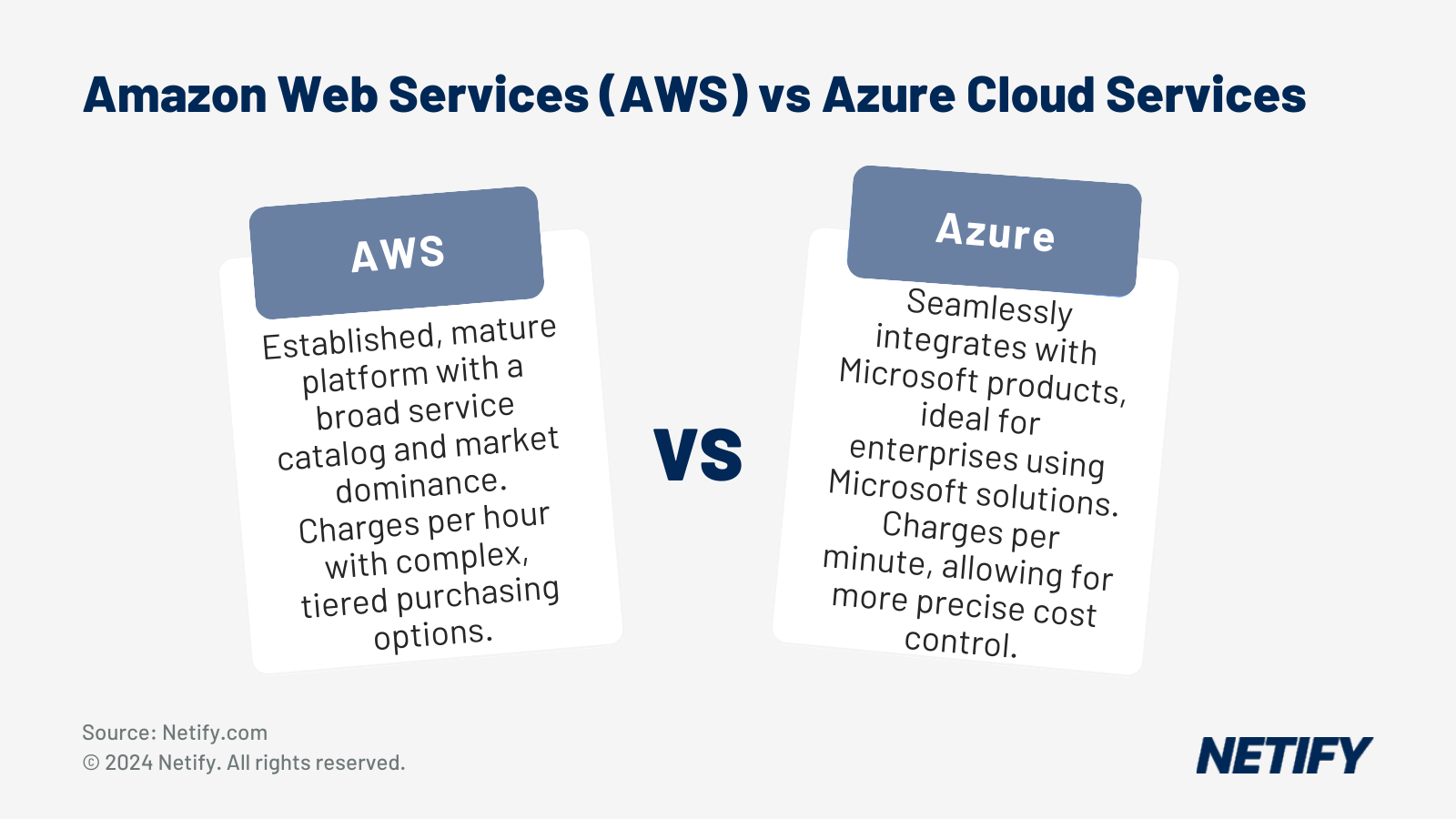
Both have a pay-as-you-go structure, so you can change or end your contract anytime if it's not working out. AWS charges per hour, with instances purchasable:
- On-demand (pay for what you use)
- Spot (bid for extra available capacity)
- Reserved (reserve an instance for 1-3 years with upfront costs based on use)
Azure charges per-minute, offering a more exact pricing model than AWS. It also offers short-term commitments allowing you to choose between monthly or pre-paid charges.
Plus, you can receive BT MPLS ExpressRoute pricing for Microsoft Azure, which means you can extend your private business network into the cloud with the functionality you need (at a price you can afford).
What are the Pros and Cons of Azure?
Microsoft was a relative latecomer to the cloud computing stage. As such, Azure is a relatively young cloud solution.
Microsoft made up the distance by working with what it already had. Essentially, it sped up Azure's development process by adapting its pre-existing on-premises solutions for the cloud.
That's good news for those who are already fans of Office, SQL Server, Windows Server, Dynamics Active Directory, Sharepoint and others.
Plus, the reality is that Microsoft is ubiquitous. So many organisations and enterprises all over the world rely on Microsoft applications and solutions. Because Azure is tightly integrated with these solutions, it fits in with other Microsoft solutions like it was always there.
As such, organisations that already rely on Microsoft solutions will have a much easier time integrating Azure than AWS (and that's quite a lot of organisations). Plus, if you're already an existing Microsoft customer, you'll get major discounts on Azure.
That said, Azure is a younger program than AWS, and that shows through in its enterprise performance. It's less enterprise-ready than AWS, which is surprising to some clients given Microsoft's long history as a leading enterprise vendor.
What are the Pros and Cons of AWS?
AWS's greatest strength is its overwhelming dominance of the market. It's been the market leader in cloud services for 10 years and it shows in the available services.
Part of its popularity is the sheer scope of operations available to users. It was the first on the market, which means it's the most mature service currently available. It has pre-existing infrastructure that many of its competitors haven't fully developed yet.
That said, AWS's biggest weakness is that it's priced like the leader of the pack.
It's not a cheap option. Worse, many companies find it difficult to make heads or tails of AWS's pricing structure, which makes it harder to effectively manage costs (and justify those costs to upper management).
That said, AWS's many strengths outweigh its weaknesses. It's spent years leading the pack for good reason, and it shows through in the service.