
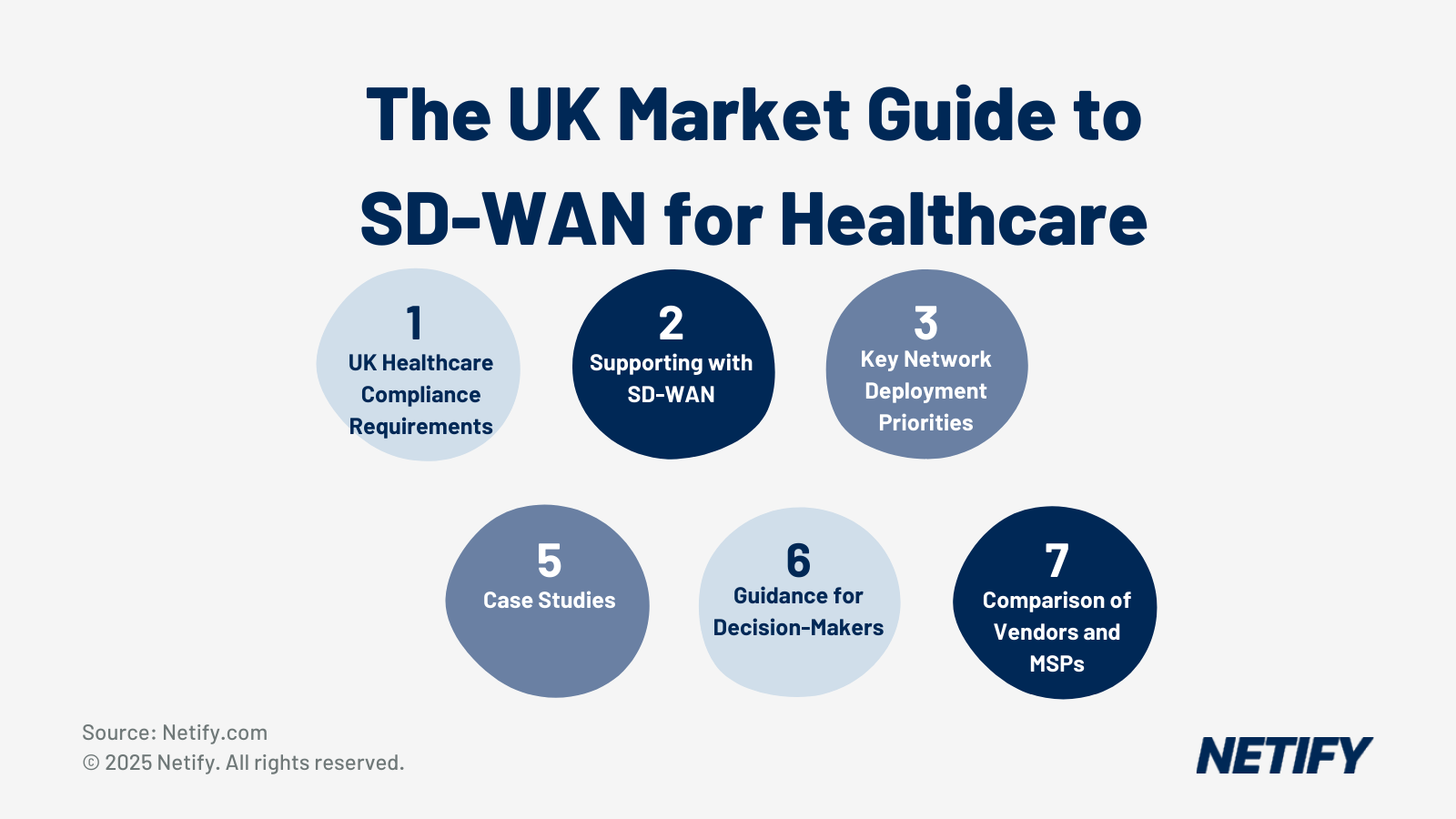
The UK Market Guide to SD-WAN for Healthcare
Modern healthcare has become reliant on computer systems, medical devices and the underlying connectivity that interlinks them all together.
Looking to build a SD-WAN or SASE RFP for healthcare?

UK Healthcare Network Compliance Requirements
Healthcare networks in the UK must comply with complex regulatory frameworks, with operations designed around safeguarding patient data and personal health information, ensuring service continuity and maintaining operational integrity.
NHS Digital Standards
NHS Digital Standards form the regulatory backbone for all healthcare technology implementations across the UK, stipulating that healthcare data and medical records are collected, managed and exchanged consistently and securely throughout the NHS and social care sector.
The NHS Digital standards encompass seven critical domains including Information Standards, Technical Standards, Clinical Risk Management, and Security and Data Protection requirements. The standards work collectively to ensure interoperability, clinical safety, data protection and accessibility, creating a secure environment where technology supports better staff and patient satisfaction.
Data Security & Protection Toolkit (DSPT)
The Data Security and Protection Toolkit (DSPT) is an online self-assessment tool used by all organisations that access or process NHS patient data and systems. The primary purpose of the DSPT is to help these organisations measure and demonstrate their compliance with key data security and information governance requirements set by the Department of Health and Social Care, given that healthcare regulations dictate that NHS systems must protect patient information from data breaches.
NIS Regulations & GDPR
The Network and Information Systems (NIS) Regulations 2018 are a set of UK laws designed to improve security and resilience of networked systems - with UK-based healthcare having to utilise the appropriate measures to manage their cyber and information infrastructure against security risks.
UK Data Protection (ICO / GDPR) and Access Management
The General Data Protection Regulation (GDPR) governs the collection, storage, processing and sharing of personal data. Processing of data must satisfy both an Article 6 condition (for personal data) and an Article 9 condition (for special category data, such as health information). The ICO is the UK’s independent regulator for data protection, responsible for enforcing the Data Protection Act 2018 and GDPR.
Want to learn more about SD-WAN for the healthcare industry?
Choosing SD-WAN for Healthcare
When choosing SD-WAN for healthcare, it's essential to consider its implications on applications that require support - which may also need integrations for the likes of privileged access management/identity and access management.
EMIS Web (GP System) ▼
EMIS Web is the UK's leading GP clinical system, enabling appointment booking, patient consultations, electronic medical records, prescriptions and data sharing across network resources and healthcare services. SD-WAN improves EMIS Web by improving reliable connectivity, reducing system outages, prioritising clinical application traffic, improving security and enabling connectivity from across multiple healthcare sites and remote users.
TPP SystmOne ▼
TPP SystmOne is a centrally hosted clinical system providing a single, shared electronic health record for all patients, used widely across UK healthcare environments. SD-WAN's dynamic path selection ensures SystmOne traffic always takes the optimal network route, reducing latency and improving clinician productivity during patient consultations. For healthcare organisations using SystmOne across multiple care settings (primary, community, acute), SD-WAN creates a consistent connection experience regardless of location or facility type.
PACS Imaging System ▼
PACS (Picture Archiving and Communication System) provides the ability to store, retrieve, share and display medical imagery across healthcare facilities, enabling radiologists and clinicians to access diagnostic images regardless of their physical location. SD-WAN's bandwidth optimisation and link aggregation techniques reduce the time required to transfer large imaging files (often 20-500MB per study) between facilities, improving diagnostic workflows and reducing reporting delays. Further to improving primary connectivity, by providing alternative connection paths, SD-WAN ensures continuous access to archived images even during primary network failures, maintaining business continuity for diagnostic services.
CT/MRI Live Imaging ▼
CT/MRI Live Imaging enables real-time visualisation of internal body structures during diagnostic procedures, requiring high-bandwidth, low-latency connections to transfer complex imaging data instantaneously. SD-WAN's prioritisation ensures sub-second response times for live imaging applications, enabling radiologists to view images in real-time without buffering or delays.
Telehealth & Video Consultations ▼
Telehealth and telemedicine services deliver health services and information remotely, enabling patient-clinician contact, monitoring, education and care beyond in-person visits for improved patient engagement. Beyond improving bandwidth for live, well-performing consultations, SD-WAN creates segmented, encrypted pathways for telehealth traffic, maintaining GDPR compliance and protecting patient information/patient-doctor communications from unauthorised access and data breaches.
Healthcare IoT & Monitoring ▼
Healthcare IoT & Monitoring utilises medical device connectivity and sensors to analyse patient health data, enabling real-time and remote patient monitoring, all of which is designed to improve patient engagement. Advanced SD-WAN implementations enable preliminary data analysis at network edge locations, filtering routine measurements whilst prioritising transmission of critical alerts and exceptions - which can significantly improve patient outcomes. On top of this, SD-WAN's network performance analytics help IT teams identify connectivity issues with critical medical devices before they impact patient care, improving equipment uptime and reliability.
Cross-site EHR Systems ▼
Cross-site EHR systems enable secure, real-time sharing of sensitive patient information and health records across different healthcare environments. When patients move between healthcare settings, SD-WAN addresses healthcare challenges, optimising the transfer of medical histories, reducing admission delays and improving care transitions. It's also worth considering that SD-WAN's logging and reporting features ensuring regulatory compliance with access controls and data protection requirements across all connected sites.
Key Network Deployment Priorities in Healthcare SD-WAN
Clinic-to-Core Connectivity
Through dynamic path selection, link aggregation and backup connection capabilities, SD-WAN enables resilient, high-speed links between remote clinics, GP surgeries and core hospital data centres. Often utilising a mix of broadband, 4G/5G and MPLS, SD-WAN allows for uninterrupted access to central EHR systems and health databases. For example, Norfolk Community Health & Care connected over 150 sites with SD-WAN, gaining improved performance and reduced outages.
The Need For Consistent Security Policies to Prevent Data Breaches
When deploying across multiple sites (or trusts), healthcare providers should consider their security policies to prevent breaches of data. One way this can be achieved is through consistent security policy making - which is made all the more easier through SD-WAN implementation.
Secure Remote Access (and Access Control)
With the growing use of telehealth services, SD-WAN provides the necessary infrastructure to facilitate secure, high-performance access to clinicians working remotely. SD-WAN often integrates zero-trust models, identity solutions and encrypted tunnels, ensuring remote staff access clinical systems safely and efficiently, with policy-based controls to protect patient data and meet regulatory compliance.
Utilising Network Segmentation To Limit Cyber Attacks
To protect patient data and comply with regulations, healthcare providers must isolate clinical, administrative, guest and IoT network traffic, therefore in the unfortunate event of a breach, the issue is contained and cannot 'leak' into other networked systems.
Cloud and Multicloud Connectivity
Cloud services used for EHR, telemedicine and analytics. SD-WAN provides direct secure access, reducing latency.
NHS Case Studies and Deployment References
To improve their network reliability and security across multiple locations, Bupa deployed Cisco Meraki SD-WAN, which ensured consistent application performance for their cloud-based health management systems. This consistency significantly improved patient care and operational efficiency, whilst also providing Bupa with better network visibility and control, allowing for more efficient management of their IT resources and improved data security measures. By prioritising crucial applications and services, Bupa reduced latency and improved the user experience across their healthcare offerings, benefitting both healthcare professionals and patients.
Similar to Bupa, Nuffield Health are one of the UK’s leading healthcare organisations, however, differs by being not-for-profit. Nuffield adopted Fortinet's offering in order to integrate their numerous healthcare facilities, providing a seamless and secure connection for their electronic health record (EHR) systems. Integrating Nuffield’s EHR systems has been integral for improved sharing of data and collaboration amongst healthcare professionals, allowing for better patient care from distributed systems and locations. Introducing Fortinet SD-WAN also enhanced Nuffield Health’s ability to manage and secure their network, with features such as encryption, privileged access and segmentation, each of these improve the confidentiality and integrity of patient data by protecting it from breaches. This was essential for Nuffield Health to remain compliant with the General Data Protection Regulation (GDPR), amongst other regulatory requirements.
Guidance for UK Healthcare IT Decision-Makers
SD-WAN provides the foundation for secure remote access, supporting clinicians and staff working outside traditional facilities. Solutions with integrated Zero Trust Network Access (ZTNA) and UK-based client support minimise latency whilst maintaining security compliance with NHS Digital guidelines.
In response to increasing cyber-attacks on NHS Trusts, SD-WAN solutions should incorporate necessary security features to combat them. Integration with Secure Access Service Edge services provides centralised security management across all sites. Implementation should include redundant links at essential sites and DDoS protection.
SD-WAN can bridge traditionally separate networks, aligning with NHS England's "One Network" vision. Solutions should support multi-domain networking and therefore it's ideal to select access-agnostic solutions compatible with newer technologies such as IoT, AI and 5G.
Utilise the expertise of Information Governance and IT security teams during procurement to ensure solutions meet DSPT, GDPR and NIS requirements. You should also look to mandate appropriate logging, encryption standards and resilience testing to ensure your network system doesn't fall foul of regulations.
Vendor Comparison (Leading SD-WAN solutions for UK healthcare providers)

Cisco
Overview
Cisco provides their SD-WAN offerings through both Meraki and Catalyst platforms, with management of Meraki typically more accessible and Catalyst more ideal for complex use cases. Cisco is offered via MSPs and Cisco Gold partners including BT, Block and Virgin Media O2, offering managed SD-WAN services to NHS trusts and private healthcare providers.
Cisco has particularly strong UK market presence through local offices and European data centres, which has been reflected by uptake as Bupa Health Clinics have deployed Cisco Meraki across multiple UK sites, whilst many NHS trusts, including Barts Health, currently utilise Cisco networking infrastructure.
Pricing follows an enterprise model with Meraki licenses tiered according to throughput requirements. Cisco's quote-based approach allows for customisation based on specific trust requirements, ensuring healthcare providers receive appropriately scaled solutions for their environments.
Key Highlights

Fortinet
Overview
Well-known for being a leader in cybersecurity, Fortinet's SD-WAN offers security-focused connectivity for UK healthcare organisations. MSPs include BT's managed SD-WAN service and Redcentric's specialised healthcare offerings. Within the UK, Fortinet maintains dedicated offices and support teams for direct assistance.
Nuffield Health, one of the UK's largest healthcare charities, implemented Fortinet SD-WAN to connect its Electronic Health Record systems across multiple facilities. Within the NHS, several Integrated Care Boards (ICBs) have adopted Fortinet solutions through managed service providers, including North Central London ICB's deployment via Redcentric.
From a pricing perspective, Fortinet positions itself in the mid-tier range for hardware and licensing costs. Most healthcare organisations utilise bundled managed service contracts with preferred integrators or via G-Cloud procurement frameworks for custom quotes.
Key Highlights

Versa Networks
Overview
Versa Networks delivers its SD-WAN primarily through managed service providers and telecommunications partners - creating an established channel partner network that includes the likes of Zen Internet and Axians. Whilst lacking a UK headquarters, Versa maintains a London office and delivers UK support.
We've seen BMI Healthcare implement Versa SD-WAN specifically to improve performance of critical applications across their facilities. This implementation showcases Versa's capability to meet the demanding connectivity requirements of healthcare environments where application availability and security absolutely must meet needs.
Pricing follows an enterprise model with tiered structures based on bandwidth and number of sites, however healthcare organisations must request customised quotes through Versa's partner network.
Key Highlights

Arista VeloCloud
Overview
VMware VeloCloud SD-WAN is offered to the UK healthcare market via managed service partners including Exponential-e and Lumen. With UK offices and cloud gateways strategically positioned across the UK and EU, VMware ensures coverage of network connections is consistent and reliable.
VeloCloud has demonstrated their ability to break into the healthcare industry, having been utilised by a large NHS Trust, offering the trust with improved security, scalability and network uptime. Notably, VMware SD-WAN technology underpins several Health and Social Care Network (HSCN) connected services, including NHS Digital's own SD-WAN project.
VeloCloud is available in subscription-style licensing models and is priced per-edge, frequently bundled into managed service packages. Healthcare providers can access VMware SD-WAN through G-Cloud via authorised partners, with pricing customised per site based on specific requirements.
Key Highlights
Managed Service Providers (Leading MSPs delivering SD-WAN to UK healthcare)

BT
Overview
BT, one of the leading UK managed service providers, offers SD-WAN solutions by partnering with several major vendors, including Cisco (both Meraki and Viptela), VMware, Fortinet, HPE Aruba, Juniper Networks and Versa Networks.
BT's SD-WAN services leverage their extensive UK infrastructure, built on the Openreach network, for arguably the most comprehensive nationwide coverage. Having already got a strong presence in the UK healthcare sector, BT provides connectivity and network services to NHS trusts, private hospitals and healthcare organisations.
BT typically offers SD-WAN services on a subscription (OPEX) basis, with optional add-ons for advanced security, cloud integration or analytics - also providing managed service options, which can include installation, monitoring, maintenance, and SLAs for uptime and performance.
Key Highlights

Virgin Media O2
Overview
Virgin Media O2 offers SD-WAN to healthcare environments through their partnerships with Versa Networks and Fortinet, offering multiple solutions to fit differing needs. With extensive UK coverage serving over 110 NHS Trusts and managing thousands of SD-WAN endpoints nationally.
Virgin Media's NHS implementation portfolio includes projects such as the UK's first 5G connected hospital at South London and Maudsley NHS Foundation Trust, whilst also supporting multi-site deployments at Norfolk Community Health & Care Trust's 70 sites and Pennine Care NHS Foundation Trust's 88 sites.
Virgin Media O2's flexible pricing model includes transitional dual-running cost support, making migration from legacy systems financially viable, delivering transparent SLAs tailored to NHS operational requirements.
Key Highlights

RedCentric
Overview
As a direct managed service provider, Redcentric both designs and implements SD-WAN solutions using Fortinet and Cisco technologies, maintaining a vendor-agnostic approach. One key case study is their deployment across a 400-site Integrated Care Board.
Procurement through NHS frameworks including RM3825 and G-Cloud, with standard pricing at £60 per device monthly.
Key Highlights

Exponential-e
Overview
Exponential-e offers its own proprietary SD-WAN solution, featuring integration with its carrier-class Layer 2 VPLS network. Coverage reaches 90% of UK businesses via 190 Points of Presence, powering 65% of NHS organisations in London.
Managed tiers (Essential, Premium, Enterprise) with security add-ons and AI-powered CSOC monitoring.
Key Highlights

Cato Networks
Overview
Cato Networks offers a SASE platform, providing global SD-WAN coverage via its private backbone, which includes points of presence across the UK. Multiple AI capabilities including policy automation and threat hunting.
Subscription-based pricing model, calculated per site, per user or based on bandwidth and security features.
Key Highlights

Harry holds a BSc (Hons) in Computer Science from the University of East Anglia and serves as a Cybersecurity Writer here at Netify, where he specialises in enterprise networking technologies. With expertise in Software-Defined Wide Area Networks (SD-WAN) and Secure Access Service Edge (SASE) architectures, Harry provides in-depth analysis of leading vendors and network solutions.
Fact-checked by: Robert Sturt - Managing Director, Netify