
How to Choose SD-WAN for the Retail Sector
The retail sector is no novice when it comes to adopting digitisation of processes, with card machines, surveillance cameras and self-checkouts forming just some of the digital practices used across major retailers. The uptake in these technologies has improved day-to-day operational efficiency, often reduced costs and has enhanced customer experiences. However, with the growing digitisation of activities, retailers are finding that previously simple systems have become complex and require a lot of focus in order to meet regulations or customer expectations.
In this article, we explore how Software-Defined Wide Area Network (SD-WAN) solutions offer a simple solution for retailers, combining flexible connectivity, improved network performance and security enhancements, to fulfil these needs.
Looking to build a SD-WAN or SASE RFP for retail?
Regulatory Compliance and Standards
PCI DSS (Payment Card Industry Data Security Standard)
The Payment Card Industry Data Security Standard (PCI DSS) is a set of rules that mandate how companies should accept, process, store and transmit credit card information, ensuring that they maintain a secure environment in order to facilitate this. With the vast majority of retailers accepting card payments, the PCI DSS rules are of essential importance to the retail sector.
These rules, first enforced in 2004, were put in place to increase control over cardholder data, reducing the risk of credit card fraud due to improperly handled credit card information. The standard has evolved significantly, with PCI DSS 4.0.1 now fully in effect as of 2025/2026. This latest version introduces several critical changes that impact how retailers should approach their SD-WAN deployments.
Key updates in PCI DSS 4.0.1 include a mandatory focus on comprehensive vulnerability management, where all vulnerabilities must be addressed, not just those classified as high-risk. The standard also now mandates scanning all removable media for malware, recognising the diverse attack vectors that threaten payment card data. Compliance is therefore crucial for businesses, with a $5,000 to $50,000 variable fine for non-compliance - and that's without including legal or settlement amounts that could arise from actual breaches.
SD-WAN can assist with meeting these strict requirements, offering retailer networks with segmentation functionality and secure communication protocols. SD-WAN efficiently segments the network, splitting traffic up based on features such as application, protocol, or priority. The separation of payment card data from other network traffic minimises the risk of payment traffic being exposed to other systems, which in the event of a breach, keeps card data isolated and outside the attack surface to prevent further compromise. Segmenting this traffic also reduces the complexity of implementing rigorous security controls, reduces the scope of PCI compliance audits, and simplifies future audit processes by providing clear network boundaries and traffic flows.
Want to learn more about SD-WAN for the retail industry?
GDPR (General Data Protection Regulation)
For retailers operating within the UK and Europe, data protection regulations have continued to evolve beyond the initial GDPR framework introduced in 2018. In the UK specifically, the Data (Use and Access) Act 2025 has amended the UK GDPR and Privacy and Electronic Communications Regulations (PECR), introducing significant changes that retailers must understand.
The Act introduces a new "recognised legitimate interest" lawful basis for processing data specifically related to crime prevention, which can be particularly relevant for retailers managing fraud prevention systems and security operations. More significantly for retail compliance, maximum fines for PECR breaches - such as violations of marketing consent rules or cookie requirements - have increased from £500,000 to up to £17.5 million or 4% of global turnover, whichever is higher. This brings PECR penalties in line with UK GDPR enforcement levels.
These regulations require that personal data must be processed for specific, explicit, and legitimate purposes, whilst also being processed securely and maintaining integrity. Retailers must consider how they process and protect personal data across Customer Relationship Management (CRM) systems, e-commerce platforms, customer service platforms, payroll systems, and marketing automation tools, to name a few.
SD-WAN is an essential tool for retailers to ensure data protection and privacy across these systems, offering encryption and secure data transmission capabilities that help adhere to the security requirements of UK GDPR and PECR. With SD-WAN, retailers can implement strong access controls and monitor data flows to evaluate vulnerabilities and view, with confidence, that they are maintaining regulatory compliance. Modern SD-WAN solutions also provide detailed logging and reporting capabilities that simplify the audit process and help demonstrate compliance to regulators.
CCTV and Surveillance Regulations
For retailers, protection isn't only limited to network activities but also extends to the physical world through CCTV and surveillance systems. In the UK, businesses must comply with the Data Protection Act 2018 and the UK GDPR, which require the lawful, fair, and transparent processing of personal data captured by CCTV. Similarly, in North America, regulations such as the California Consumer Privacy Act (CCPA) in California and the Personal Information Protection and Electronic Documents Act (PIPEDA) in Canada enforce strict guidelines on the use and protection of CCTV data, ensuring consumer privacy and data security.
This means that retailers must put security systems in place to manage their surveillance infrastructure, and SD-WAN facilitates this by providing secure and efficient transmission of CCTV data across multiple retail locations. This not only fulfils the security requirements of the regulations but also reduces the complexity of managing multiple sites' surveillance systems, ensuring overall compliance with surveillance regulations whilst providing centralised visibility and control.
Key Considerations for SD-WAN in Retail
Data Protection and Security
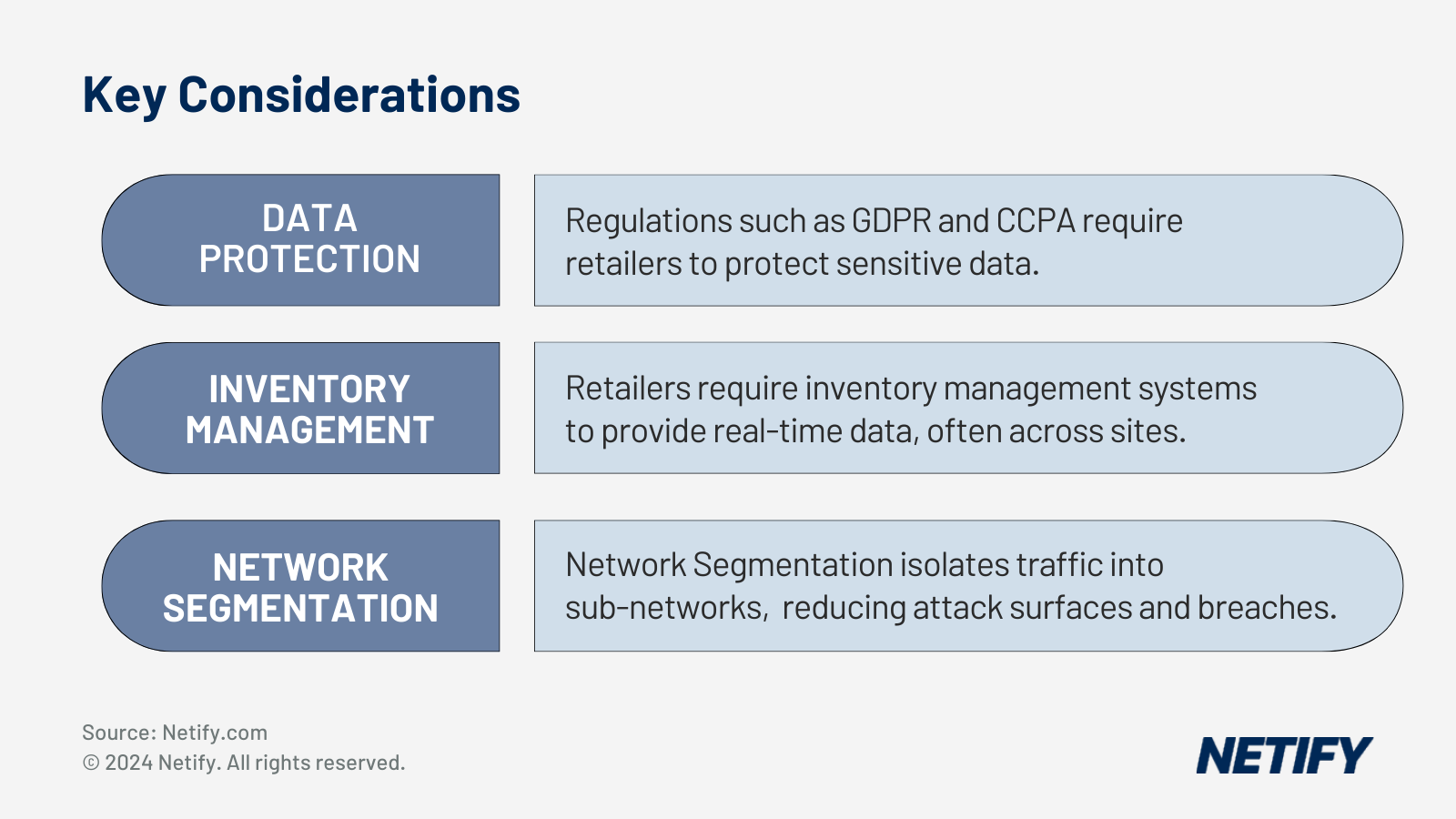
GDPR isn’t the only regulation for protecting retail customer’s personally identifiable information (PII) and financial data. The California Consumer Privacy Act (CCPA), focusing on consumer rights and data protection for residents of California, which is similar to GDPR.
Some of the security features that SD-WAN implements to enhance retail security are encryption, intrusion detection, and real-time monitoring of traffic. These features provide a secure network for retailers, helping to meet data protection criteria by safeguarding sensitive data, which in turn maintains customer trust.
Stock Control and Inventory Management
Arguably the most important system for retailers is an Inventory Management System (IMS) or stock control system. Without it, retailers are left in the dark as to what stock needs re-ordering and how much of each item is on display shelves. This problem is also magnified when considering large scale retailers, who are dependent on cloud-based IMS and downtime to these systems can be detrimental to business operations. Retailers therefore deem protecting these systems crucial for day-to-day activities, alongside real-time connectivity to ensure data is not outdated.
SD-WAN enables the seamless integration of inventory management systems, providing retailers with real-time stock tracking and control. By also integrating with cloud services, SD-WAN can create a reliable connection for multiple sites, interconnecting point-of-sale (POS) systems and stock systems, whilst also reducing potential downtime. These improvements over traditional WAN networks means that retailers can optimise their inventory management processes, which can also yield greater operational efficiency and profits.
Network Segmentation
One of the key security features that SD-WAN provides for retailers is it’s network segmentation capability. Network segmentation isolates network traffic, applications or data into their own subsections of the network. Often considered as a foundational security strategy, segmentation can be utilised to improve network performance and also to prevent lateral movement in the event of a breach. This allows retailers to create isolated network segments for different operations, such as Point-of-Sale (POS), CCTV, and customer Wi-Fi. By introducing network segmentation, retails can reduce the attack surface from potential breaches, ensuring security compliance by preventing unauthorised access between segments through lateral movement.
UK vs. North American Compliance Differences
UK Compliance Requirements
In the UK, due to GDPR and the Data Protection Act, SD-WAN deployments in the UK retail sector must prioritise data privacy, secure data transmission, and granular access controls to meet these requirements.
North American Compliance Requirements
For North America, while GDPR may not directly apply, retailers should still prioritise data protection and privacy, especially if they offer services that are still accessible for UK or European-based consumers.
Due to GDPR not being as much of a concern of North American retailers, PCI DSS is the primary compliance standard for retailers. When choosing an SD-WAN solution, IT decision makers must select an SD-WAN solution that is PCI-compliant and provide security features to protect payment card data.
Best Practices for Implementing SD-WAN in Retail
Choosing a PCI-Compliant SD-WAN Solution
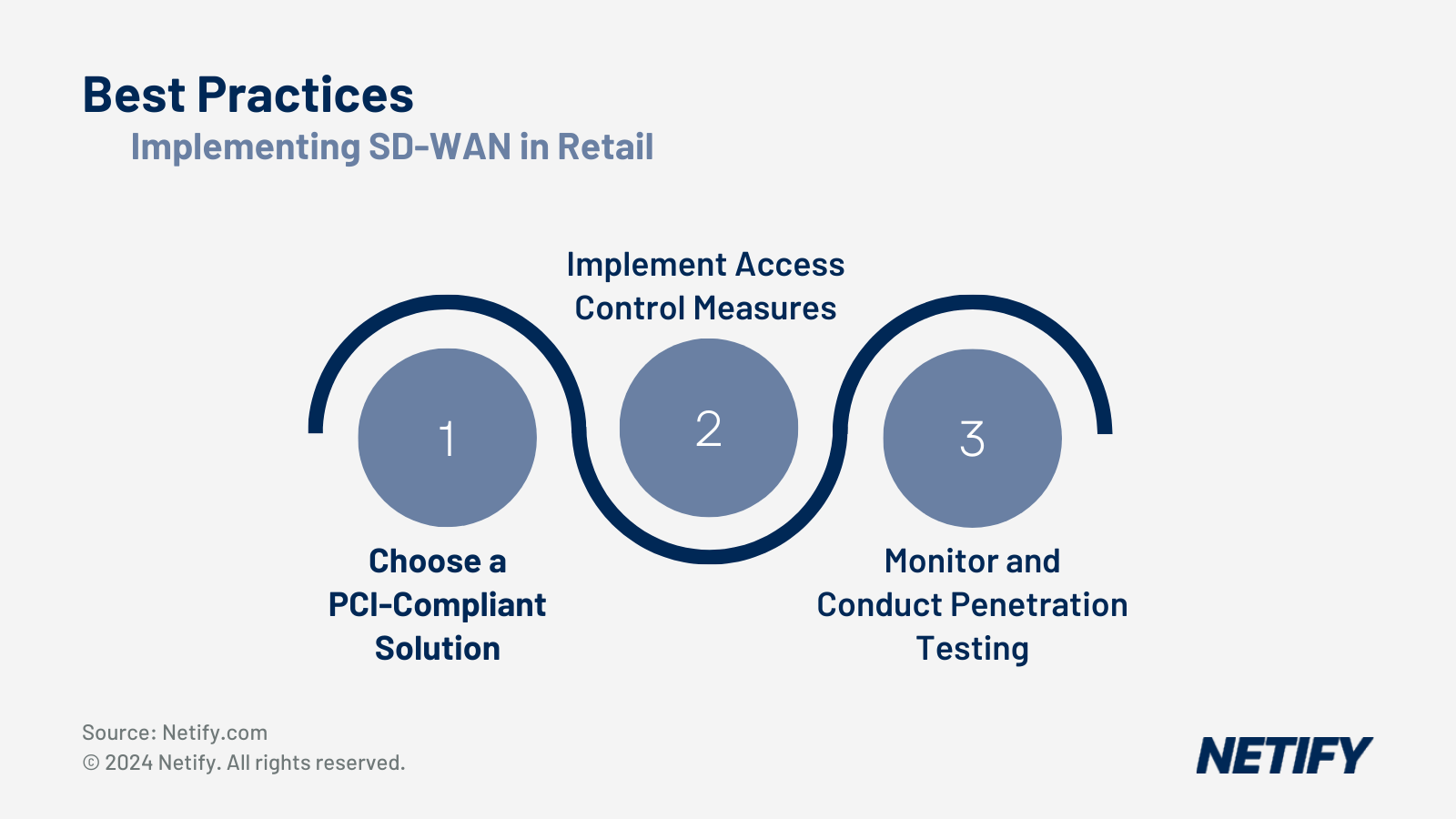
Retailers should select a PCI-compliant SD-WAN vendor that provides the necessary security features to meet the stringent requirements of PCI DSS 4.0.1. A robust PCI-compliant SD-WAN solution offers network segmentation to isolate credit card traffic from other systems, ensures reliability of connections through redundant pathways and fail-over capabilities, and provides comprehensive reporting functionality to simplify the audit compliance process.
We would recommend that retailers select an SD-WAN vendor that has achieved PCI DSS Attestation of Compliance (AoC) as a Level 1 Service Provider - the highest security standard - but, failing that, retailers should at a minimum ensure the SD-WAN solution is certified as PCI-compliant. This certification can significantly reduce the scope and cost of your own PCI compliance efforts, which reduces complexity and workload for your network administrators.
Given the enhanced vulnerability management requirements in PCI DSS 4.0.1, retailers should also verify that their SD-WAN solution includes automated vulnerability scanning capabilities and integrates with Security Information and Event Management (SIEM) systems for comprehensive monitoring of all payment-related network segments.
Implementing Strong Access Control Measures
When focusing on protection of any system through access control, the most secure approach would be to deny all access. Whilst this isn't practical for business operations, retailers can utilize SD-WAN solutions' Principle of Least Privilege (POLP), in which users, devices, and applications are only granted the minimum access required to conduct their duties. This granular access control and network policy enforcement ensures that only authorised personnel can access sensitive data and systems, helping to adhere to GDPR, UK data protection regulations, and PCI DSS requirements.
Modern SD-WAN implementations should incorporate Zero Trust Network Access (ZTNA) 2.0 capabilities, which have become a core component of retail security frameworks. ZTNA 2.0 goes beyond traditional network-based access controls to verify user and device identity, assess security posture, and enforce least-privilege access policies on a per-session basis. This approach is particularly important for protecting POS terminals and limiting the impact of potential breaches, as it ensures that even if credentials are compromised, attackers cannot move laterally across the network.
Retailers should also implement multi-factor authentication (MFA) for all administrative access to SD-WAN management interfaces and highly privileged accounts. This additional layer of protection is essential in an environment where credential-based attacks have become increasingly sophisticated.
Regular Monitoring and Testing
Given that the threats retailers face are frequently changing and becoming more complex, continuously monitoring network activity and conducting in-depth vulnerability assessments is essential to maintain a secure SD-WAN network that protects systems and helps meet regulatory requirements. Advanced SD-WAN solutions now provide a unified, single-pane-of-glass view of network traffic and security systems in action, which can be used alongside vulnerability testing to identify potential weaknesses before they can be exploited.
Modern SD-WAN platforms are increasingly incorporating Autonomous Digital Experience Management (ADEM) capabilities, which use AI to diagnose and fix network issues before they impact the customer checkout experience. These systems can automatically detect performance degradation, security anomalies, and potential attack indicators, then either alert administrators or take automated remediation actions based on predefined policies.
It is essential that retailers conduct regular vulnerability scans and penetration tests of the network, as this helps to identify and address potential security gaps, ensuring ongoing compliance. These tests are a requirement for retailers to be considered PCI DSS 4.0.1 compliant, with the audit process being significantly assisted by choosing a PCI-compliant SD-WAN vendor whose infrastructure has already been validated against these stringent standards.
Retailers should also establish a continuous monitoring program that includes regular reviews of SD-WAN configurations, access logs, and traffic patterns. This proactive approach helps identify insider threats, detect compromised credentials, and ensure that security policies remain effective as the network evolves and new threats emerge.
Conclusion
Retailers face a wide array of networking complexities, ranging from operational efficiency, connectivity, security and regulatory compliance. By choosing the correct SD-WAN solution to suit their needs, retailers can utilise features such as network segmentation, secure data transmission and real-time monitoring to meet compliance criteria for regulations such as PCI DSS and GDPR. Other integrations, such as for surveillance systems and inventory management systems are also essential for maintaining day-to-day activities.

Harry holds a BSc (Hons) in Computer Science from the University of East Anglia and is ISC2 Certified in Cybersecurity (CC). He serves as a Cybersecurity Writer here at Netify, where he specialises in enterprise networking technologies. With expertise in Software-Defined Wide Area Networks (SD-WAN) and Secure Access Service Edge (SASE) architectures, Harry provides in-depth analysis of leading vendors and network solutions.
Fact-checked by: Robert Sturt - Managing Director, Netify
 Robert Sturt
Further Reading: What challenges does Retail face?